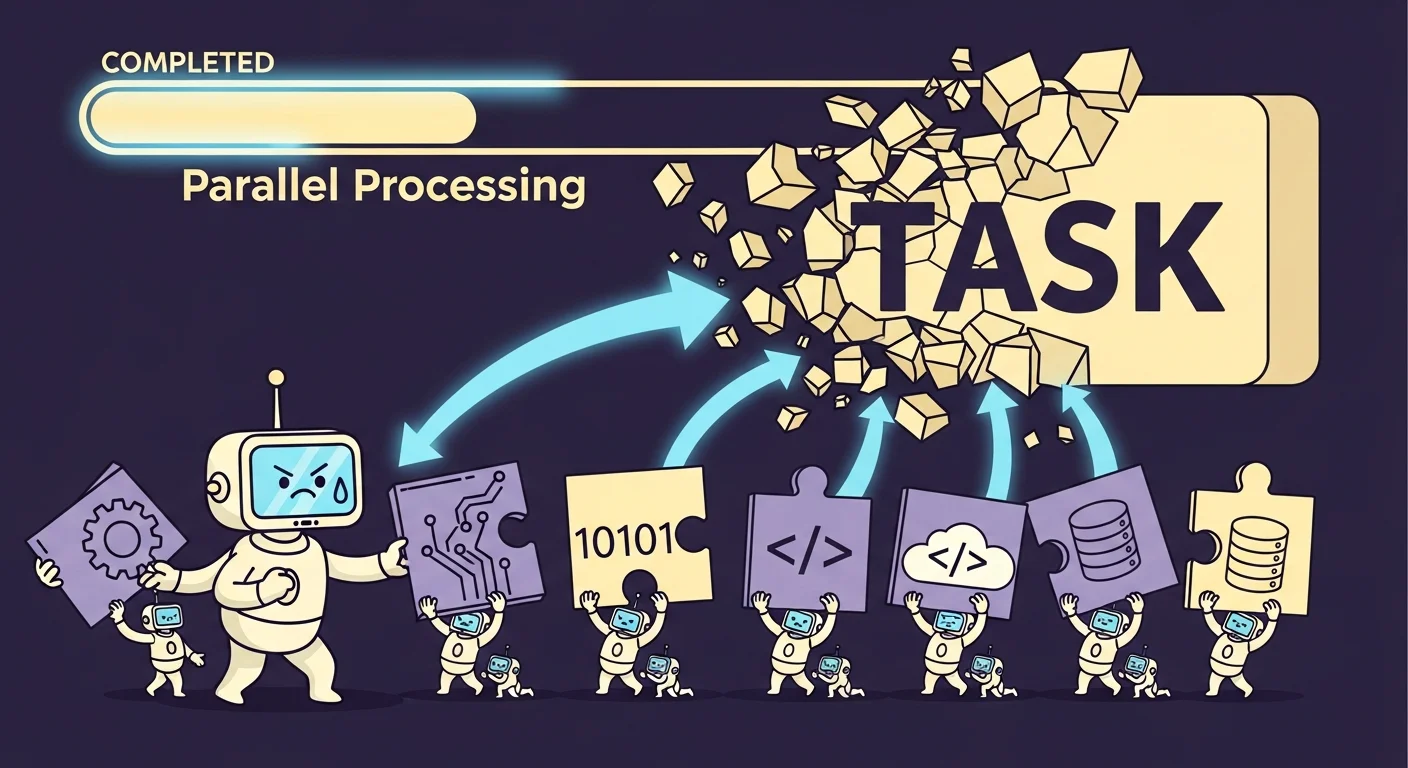
What RAO Is
Recursive agents, as defined in the RAO paper, are models capable of instantiating copies of themselves to handle decomposed portions of a larger task. The core problem the method addresses is twofold. First, standard single-agent systems are bounded by fixed context windows, which caps the complexity of tasks they can process in a single pass. Second, agents trained on problems of a given difficulty level typically fail to generalize to harder problems at inference time. RAO frames both constraints as solvable through structured self-delegation, where a parent agent breaks a problem into sub-tasks and hands each to a child instance of itself [1].
How the Training Method Works
RAO provides a reinforcement learning framework that teaches agents when and how to delegate. Rather than hard-coding a decomposition strategy, the training process rewards agents for making effective delegation decisions. The model learns two distinct behaviors: recognizing which tasks benefit from recursive breakdown and communicating the right information to child instances so those instances can complete their assigned sub-tasks without access to the full parent context. This learned communication protocol is central to the method, because child agents operate with only the information passed down to them, not the entire problem state [1].
The reinforcement learning signal is applied across the recursive structure, meaning the parent agent is rewarded based on the aggregate outcome of its children’s work. This end-to-end training objective aligns the parent’s delegation strategy with actual task success rather than with intermediate proxies.
Inference-Time Scaling Mechanics
At inference time, RAO implements divide-and-conquer recursion as a scaling algorithm. When a parent agent encounters a task, it can choose to handle the task directly or spawn one or more child agents, each receiving a sub-task description derived from the parent’s decomposition. Child agents can themselves spawn further child agents if their assigned sub-tasks remain too complex, creating a recursive tree of agents [1].
Parent and child agents communicate through structured handoffs. The parent encodes the relevant context for each sub-task and passes it to the corresponding child instance. Results from child agents are then aggregated by the parent to produce a final output. Because each agent in the tree operates within its own context window, the overall system can process inputs and task chains that would overflow any single instance’s memory.
Measured Performance Gains
The RAO paper reports several categories of improvement over single-agent baselines. Agents trained with RAO demonstrate better training efficiency, reaching effective performance levels with less training than comparable non-recursive approaches. On context generalization, recursive agents successfully handle tasks that exceed the model’s context window, a capability single-agent systems cannot replicate without external memory or retrieval mechanisms [1].
On task difficulty generalization, RAO-trained agents perform on problems substantially harder than those encountered during training, which the authors attribute to the divide-and-conquer structure allowing the agent to reduce hard problems to combinations of easier ones. The paper also reports reduced wall-clock time relative to single-agent systems on applicable tasks, suggesting that parallel execution across child agents contributes to practical throughput gains [1].
Scope and Limitations
The RAO paper validates the approach across experimental settings designed to probe context scaling and difficulty generalization, though the authors do not claim evaluation across the full range of real-world agentic deployments. Open questions remain around how the method performs when task decomposition is ambiguous or when sub-tasks have strong interdependencies that resist clean separation. The communication protocol between parent and child agents also introduces overhead, and the paper notes that the quality of the handoff encoding affects downstream child performance. How RAO interacts with very large base models or domain-specific fine-tuned models is not fully characterized in the current work [1].
Implications for Agent System Design
For practitioners building multi-agent or long-horizon task systems, RAO offers a training-level solution to context and complexity scaling rather than a purely architectural one. Existing approaches to long-context tasks often rely on retrieval-augmented generation, external memory stores, or hand-engineered orchestration layers. RAO suggests that a model can internalize delegation strategy through reinforcement learning, reducing the engineering burden on the orchestration layer [1].
The finding that recursive agents generalize to harder problems than those seen in training is particularly relevant for teams deploying agents in environments where task difficulty is variable or unpredictable. Systems built on RAO-trained models could, in principle, handle task distributions that shift beyond the training regime without requiring retraining.
FAQ
Q. Does RAO require a custom model architecture, or can it be applied to existing transformer-based models? The RAO paper describes a training method rather than an architectural change, which implies it can be applied to existing model classes. However, the paper does not enumerate specific compatible base models or provide integration guidance for off-the-shelf systems [1].
Q. How does RAO handle tasks where sub-tasks are interdependent and cannot be cleanly separated? The authors identify strong sub-task interdependencies as an open question and a potential limitation. The current framework is best suited to tasks that admit clean decomposition; performance on tightly coupled sub-tasks is not fully characterized [1].
Q. Does the recursive spawning of child agents increase total compute cost compared to a single-agent baseline? The paper reports reduced wall-clock time in applicable settings, attributing this partly to parallel execution across child agents. Total compute cost depends on the depth of recursion and the number of child agents spawned, which varies by task [1].
Q. Can child agents themselves use RAO-style delegation, or is recursion limited to one level? The RAO framework explicitly supports multi-level recursion. Child agents can spawn their own child agents if their assigned sub-tasks remain too complex, creating a tree structure of arbitrary depth [1].
Q. How is the reinforcement learning reward signal propagated through a multi-level recursive tree? The parent agent is rewarded based on the aggregate outcome of its children’s work, aligning the delegation strategy with end-to-end task success. The paper does not detail the exact credit assignment mechanism across deeper recursion levels [1].
Key takeaways
- RAO is a reinforcement learning training method that teaches agents to spawn child instances of themselves and delegate sub-tasks, enabling divide-and-conquer reasoning at inference time [1].
- Recursive agents trained with RAO can process tasks exceeding a single model’s context window by distributing work across child agents, each operating within its own context [1].
- RAO-trained agents generalize to tasks harder than those seen during training, a property the authors attribute to recursive decomposition reducing complex problems to combinations of simpler ones [1].
- The method reports better training efficiency and reduced wall-clock time compared to single-agent baselines, with parallel child execution contributing to throughput [1].
- Open questions remain around ambiguous decomposition, interdependent sub-tasks, and compute cost scaling at deeper recursion levels [1].