The Coordination Problem in Multi-Agent LLM Systems
As large language models move into production deployments involving multiple cooperating agents, two distinct failure modes have emerged. The first is over-structure: teams built around fixed roles, rigid pipelines, or task decompositions assigned before execution begins. These systems are predictable but brittle, unable to adapt when tasks evolve or when early assumptions prove incorrect.
The second failure mode is under-structure. Fully unstructured teams allow agents to explore and adapt freely, but that flexibility carries costs. Error propagation between agents, inter-agent conflicts over shared resources, and redundant outputs consume time and tokens without producing proportional gains in output quality [1]. Neither extreme handles the partial observability and communication constraints that characterize real collaborative workloads.
What LATTE Is
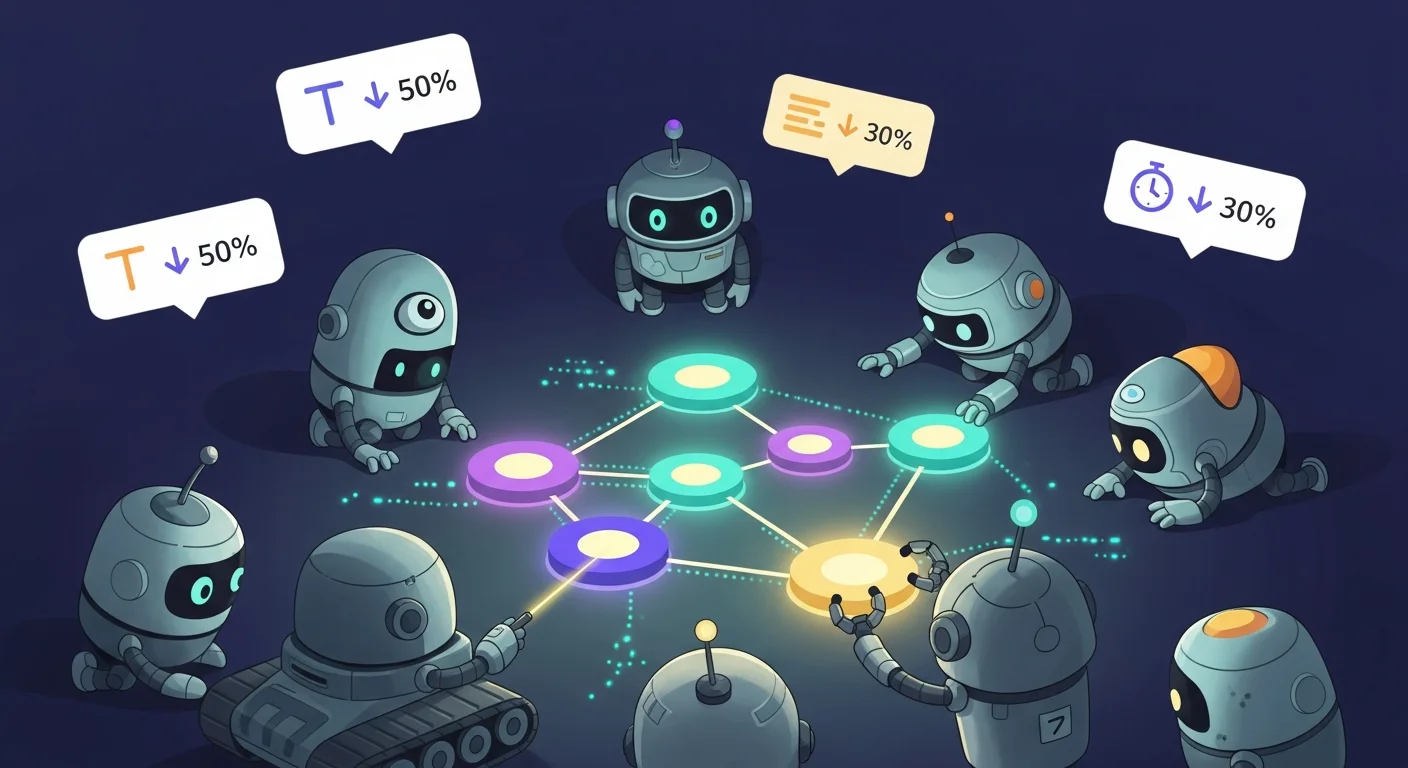
LATTE draws its design philosophy from distributed systems, where independent processors must coordinate under conditions of incomplete information and constrained communication channels. The central artifact in LATTE is a shared, evolving coordination graph that all agents in a team can read and update [1].
Rather than receiving a fixed assignment at the start of a task, agents participate in constructing the graph itself. The framework positions the graph as the primary coordination mechanism, replacing both the rigid role definitions of structured pipelines and the ad hoc messaging of unstructured teams. Because the graph is shared and continuously updated, it functions as a single source of truth about what work exists, who is doing it, and how far along each sub-task has progressed.
How the Coordination Graph Works
The coordination graph encodes three categories of information: sub-task dependencies, individual agent assignments, and the current completion state of each sub-task [1]. When an agent picks up a unit of work, it updates the graph to reflect that assignment. When it completes the work or discovers that a sub-task needs to be split into smaller pieces, it updates the graph again.
This design addresses partial observability directly. No single agent needs a complete picture of the overall task at any moment. Instead, each agent reads the graph to understand what is available, what is blocked, and what has already been completed. The protocol maintains consistency across the team while still allowing agents to dynamically allocate work, adapt their coordination strategy, and identify new sub-tasks that were not apparent at the outset [1]. The result is a system that can respond to emerging complexity without descending into the conflicts and redundancies that plague unstructured approaches.
Benchmark Results and Comparisons
The researchers evaluated LATTE across multiple collaborative task types and a range of base models. Measured against four established coordination designs, including MetaGPT, decentralized teams, top-down Leader-Worker hierarchies, and static decompositions, LATTE reduced token usage, wall-clock time, and inter-agent communication volume [1].
Coordination failures, specifically file conflicts and redundant outputs, also declined. On accuracy metrics, LATTE matched or exceeded the comparison systems across the tested benchmarks [1]. The combination of lower resource consumption and comparable or better accuracy represents a meaningful operational trade-off for teams running multi-agent workloads at scale, where token costs and latency accumulate quickly.
Scope and Applicability
The evaluation covered multiple collaborative task types rather than a single narrow benchmark, and the researchers tested LATTE with a variety of base models rather than a single LLM [1]. That breadth suggests the framework is not tuned to one model family or one class of problem.
However, the published results reflect controlled benchmark conditions. Tasks that require real-time tool use, long-horizon memory beyond the graph structure, or highly specialized domain reasoning may surface limitations not visible in the current evaluation set. Engineers considering adoption should treat the benchmark results as indicative of the framework’s coordination efficiency rather than as guarantees for arbitrary production workloads.
FAQ
Q. Does LATTE require a specific base LLM, or is it model-agnostic? The researchers tested LATTE across a variety of base models, suggesting the framework is not tied to a single LLM family [1]. Teams using different underlying models should be able to adopt the coordination graph protocol without model-specific modifications.
Q. How does LATTE handle situations where a sub-task turns out to be more complex than initially represented in the graph? Agents can discover new tasks during execution and update the coordination graph to reflect that complexity [1]. The graph is designed to evolve rather than remain static, so sub-tasks can be decomposed further as work progresses.
Q. What kinds of coordination failures does LATTE specifically reduce? The paper identifies file conflicts and redundant outputs as the primary coordination failure modes that LATTE addresses [1]. These arise in unstructured teams when multiple agents work on overlapping sub-tasks without awareness of each other’s progress.
Q. How does LATTE compare to MetaGPT in terms of accuracy, not just efficiency? Across the tested benchmarks, LATTE matched or exceeded the accuracy of MetaGPT while also reducing token usage and wall-clock time [1]. The paper does not report cases where MetaGPT outperformed LATTE on accuracy metrics.
Q. Is the coordination graph stored centrally or distributed across agents? The graph is described as shared among the team, consistent with the distributed-systems inspiration of the framework [1]. The paper does not detail a centralized storage architecture, positioning the graph instead as a shared protocol that all agents read and write.
Key Takeaways
- LATTE replaces both rigid pre-assigned pipelines and unstructured agent collaboration with a shared, dynamically updated coordination graph that encodes sub-task dependencies, assignments, and progress state [1].
- The framework draws on distributed-systems principles to handle partial observability, allowing agents to coordinate without any single agent holding a complete view of the overall task [1].
- Across benchmarks, LATTE reduced token usage, wall-clock time, and communication overhead while matching or exceeding the accuracy of MetaGPT, Leader-Worker hierarchies, decentralized teams, and static decompositions [1].
- Coordination failures including file conflicts and redundant outputs declined under LATTE, which has direct cost implications for production multi-agent deployments.
- The framework was tested across multiple task types and base models, suggesting applicability beyond a single problem class, though production generalizability remains to be validated in real-world deployments.